



The General Data Protection Regulation (GDPR) establishes strict requirements for organizations that process personal data of EU residents. While GDPR does not explicitly mandate penetration testing (similar to SOC 2), Article 32 requires organizations to regularly test and evaluate the effectiveness of their security measures. The accepted method for this testing is penetration testing.
Auditors and regulators expect more than automation-heavy tests. Vulnerability scans and AI-driven penetration testing tools have their place, but they don’t prove your defenses work against a skilled attacker. If your penetration test looks like a checkbox exercise, auditors may reject it and require retesting with a vendor that delivers realistic, expert-led testing. Don’t put yourself in a position where you’re paying for two penetration tests, do it right the first time. This article explains GDPR requirements, how penetration testing supports compliance, and what your organization needs to do in 2026.
What is GDPR in Cybersecurity?
GDPR is a data protection law enacted by the European Union that governs how organizations collect, process, store, and protect personal data of individuals in EU member states. From a cybersecurity perspective, GDPR requires organizations to implement technical and organizational measures that properly safeguard data confidentiality, integrity, and availability (CIA).
The regulation applies to any organization, regardless of geographic location, that processes personal data of EU residents. This includes companies based in the United States, Asia, or anywhere else that handles EU data subject information.
GDPR’s cybersecurity centers focus on:
- Protecting personal data against unauthorized access, disclosure, or destruction
- Implementing appropriate security controls based on risk assessment
- Regular testing, assessing security measures to ensure ongoing effectiveness
- Responding to breaches within 72 hours of discovery
Critically, non-compliance carries heavy penalties of up to €20 million or 4% of annual global turnover, whichever is higher. Considering these penalties, the ROI of high-quality penetration testing is massive if it prevents even a single breach. Equally massive are the risks associated with settling for a checkbox test.
GDPR Cybersecurity Requirements You Must Follow
Article 32 of GDPR outlines the core GDPR requirements. It mandates that organizations implement “appropriate technical and organizational measures to ensure a level of security appropriate to the risk.” In this context, appropriate is synonymous with the level of threat your organization is likely to face in a real-world attack scenario. For this reason, threat-led penetration testing is the ideal match for GDPR.
Encryption and Pseudonymization
GDPR explicitly recommends encryption as a security measure. Organizations should encrypt personal data both at rest and in transit. Pseudonymization of processing data is also recommended so it cannot be attributed to a specific individual without additional information, it provides another layer of protection.
Confidentiality, Integrity, and Availability
Organizations must ensure ongoing confidentiality, integrity, availability, and resilience of processing systems and services. This encompasses access controls, data validation, redundancy, and disaster recovery planning.
Restoration and Recovery Capabilities
GDPR requires the ability to restore access to personal data in a timely manner following a physical or technical incident. Backup systems, incident response plans, and business continuity measures are essential.
Regular Testing, Assessing, and Evaluating
Article 32(1)(d) requires “a process for regularly testing, assessing and evaluating the effectiveness of technical and organizational measures for ensuring the security of the processing.” This is where services like threat-led penetration testing become critical, they provide the evidence that your controls actually work when challenged with real-world attack scenarios.
Does GDPR Require Penetration Testing?
Direct Requirements vs. Expectations
GDPR does not explicitly require penetration testing by name. The regulation uses principles-based language, requiring “appropriate” security measures and “regular testing” without specifying exact methodologies.
However, regulators and auditors interpret Article 32’s “regular testing” requirement to include realistic penetration testing, not just automated scans or AI. The UK Information Commissioner’s Office (ICO) specifically recommends penetration testing to “simulate real-world attacks and assess the system’s resilience.” When demonstrating compliance, organizations must provide evidence that their security controls can withstand actual attack scenarios, not just pass vulnerability scans or AI penetration tests.
In practice, high-quality threat-led penetration testing has become an expectation for organizations processing significant amounts of personal data or sensitive categories of data. Auditors want to see that you’ve tested your defenses realistically, the way real attackers would test them.
Why Vulnerability Scanning Alone Is Not Enough
A significant gap exists between when vulnerabilities or attack techniques are discovered and when they become public domain. A second gap exists between when they become public and when they are integrated into automated tools. Because automated technologies like vulnerability scanners and AI are only capable of testing for known vulnerabilities, their coverage is directly affected by this gap.
Additionally, automated systems cannot replicate a skilled human attacker because they lack creativity, intuition, and the ability to learn from experience. For these reasons, organizations should be wary of vendors that depend heavily on automation to satisfy GDPR’s testing requirements.
Vulnerability scanning and AI fall short because:
- They can only detect known vulnerabilities, leaving coverage gaps for zero-days and emerging attack techniques
- They miss business logic flaws and chained attack paths that require human reasoning
- They cannot test human factors like susceptibility to social engineering
- They generate false positives and false negatives that require human verification
- They cannot reliably demonstrate actual exploitability or real-world impact
- They lack the intuition and creativity that skilled human attackers bring to every engagement
Genuine, realistic threat penetration testing is conducted by skilled human testers and validates whether your security controls can prevent, detect, and contain real attacks. This provides the evidence auditors need to confirm your Article 32 compliance. 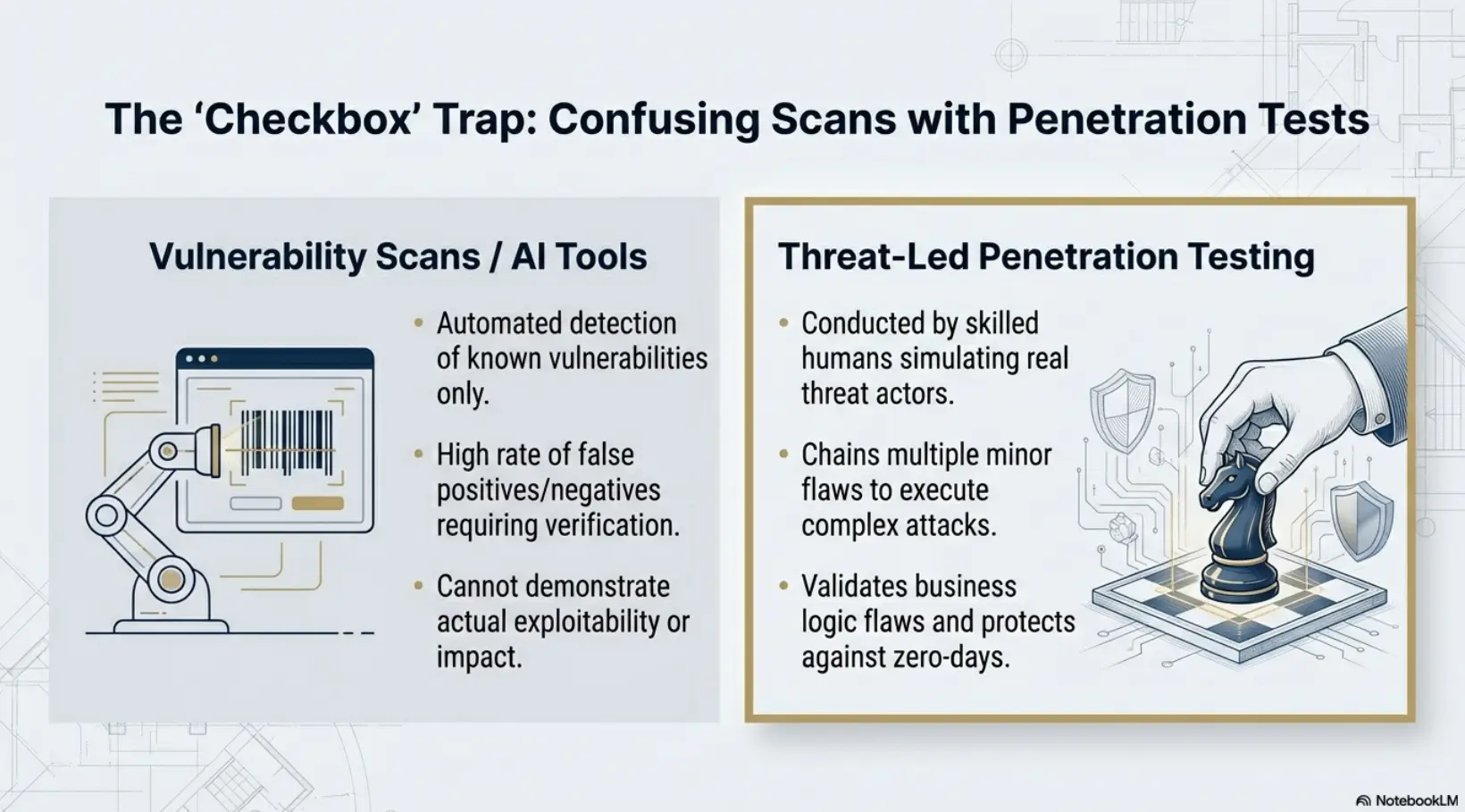
GDPR Penetration Testing Requirements
Organizations subject to GDPR should conduct realistic threat penetration testing that covers all systems processing personal data. This includes systems that collect, store, transmit, or display personal data but the scope doesn’t stop there. Adjacent systems that can access personal data, even if they don’t routinely process it, should also be tested.
These adjacent systems are what form the chain for the path to compromise. They can include administrative interfaces, backup systems, and third-party integrations with access to personal data environments and more. The scope and frequency of testing depend on your risk profile, data sensitivity, and regulatory expectations.
Types of Penetration Testing for GDPR Environments
- External Penetration Testing: Tests internet-facing systems and network perimeters that could expose personal data
- Internal Penetration Testing: Emulates insider threats or compromised credentials to test access controls around sensitive data
- Web Application Testing: Identifies vulnerabilities in applications that collect, display, or process personal data
- API Testing: Evaluates security of Application Program Interfaces that transmit personal data between systems
- Cloud Security Testing: Assesses configurations and access controls in AWS, Azure, GCP, or other cloud environments storing personal data
- Social Engineering Testing: Tests employee awareness and organizational defenses against phishing, pretexting, and other human-targeted attacks
How Often Should You Test?
GDPR requires “regular” testing but does not specify frequency. The reality is defenders need to get it right every time while attackers only need to get it right once. Test frequency should match the pace at which new security vulnerabilities are introduced.
Industry best practices recommend:
- Annual penetration testing at minimum for all systems processing or within proximity to personal data
- Testing after significant changes to infrastructure, applications, or business processes
- Testing following security incidents to validate remediation effectiveness
- More frequent testing for high-risk environments processing sensitive data categories
How Penetration Testing Supports GDPR Compliance
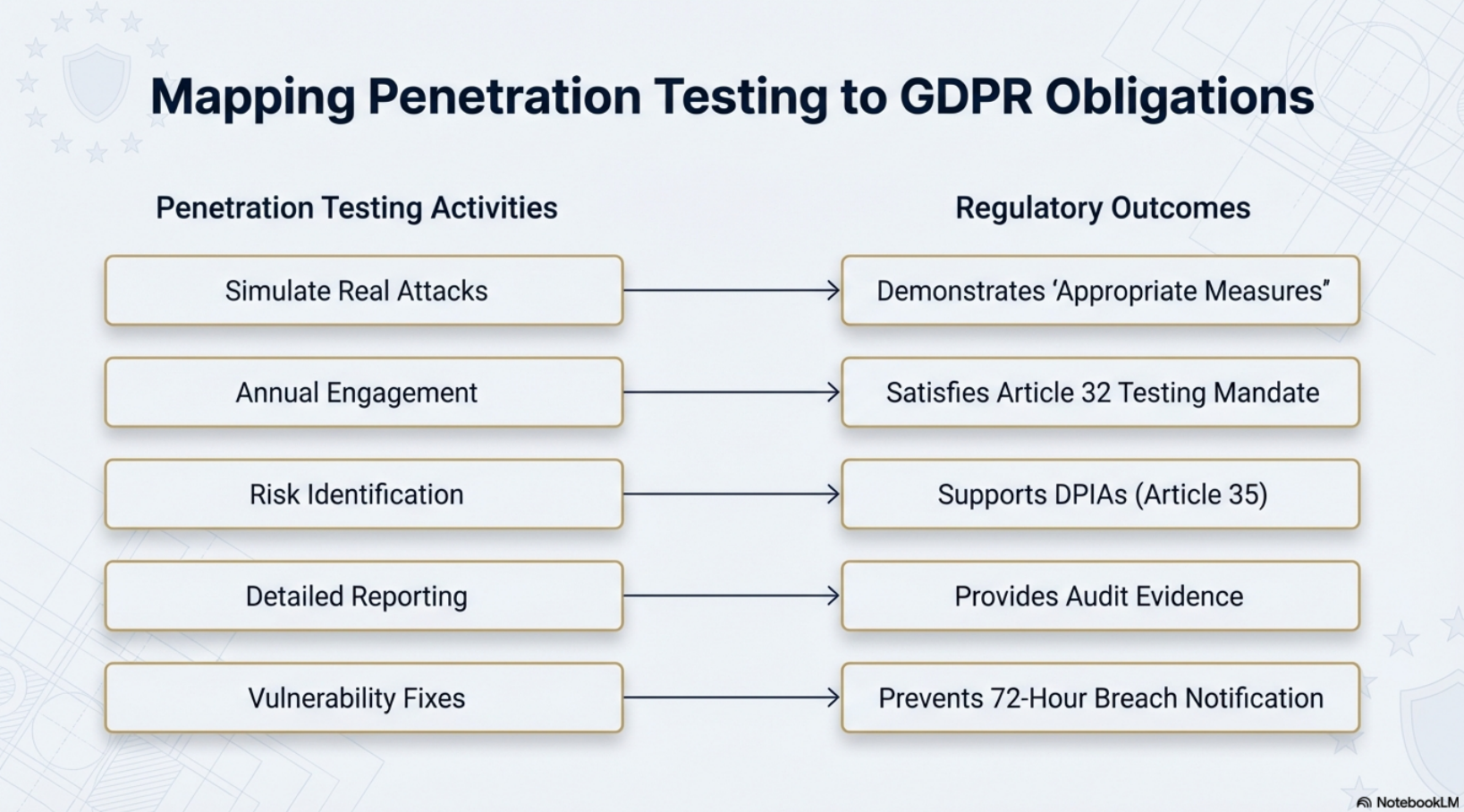
Penetration testing directly supports multiple GDPR requirements:
- Demonstrates “appropriate” security measures —Testing proves your controls are proportionate to the risks you face
- Satisfies the testing requirement — Article 32(1)(d) mandates regular evaluation of security effectiveness
- Supports Data Protection Impact Assessments (DPIAs) — Penetration test results inform risk assessments required under Article 35
- Provides audit evidence — Detailed reports document your security posture for regulators
- Identifies vulnerabilities before attackers do — Proactive testing helps prevent breaches that trigger 72-hour notification requirements